Spiritual and religiousEast AsiaBuddhist
Gozan no Okuribi
In its own language: 五山送り火
Five giant bonfires lit across Kyoto's hills to bid farewell to ancestor spirits.

Gozan no Okuribi is a summer ritual in Kyoto, Japan, marking the close of the Obon season each August sixteenth. Five massive bonfires in the shape of characters and symbols are kindled on the surrounding mountains, guiding visiting ancestral spirits on their journey back to the other world.
When is Gozan no Okuribi marked?
Gozan no Okuribi is kept as part of Obon, which runs from 13 to 15 August 2027.
Gozan no Okuribi, often known simply as Daimonji, is an evening fire ceremony held every summer in Kyoto, Japan. As the annual Obon period draws to an end, five monumental bonfires illuminate the mountain slopes enclosing the city. The fires serve as a ceremonial send-off, escorting the spirits of deceased relatives as they depart the human realm and travel back to the realm of the dead.
The five mountain fires
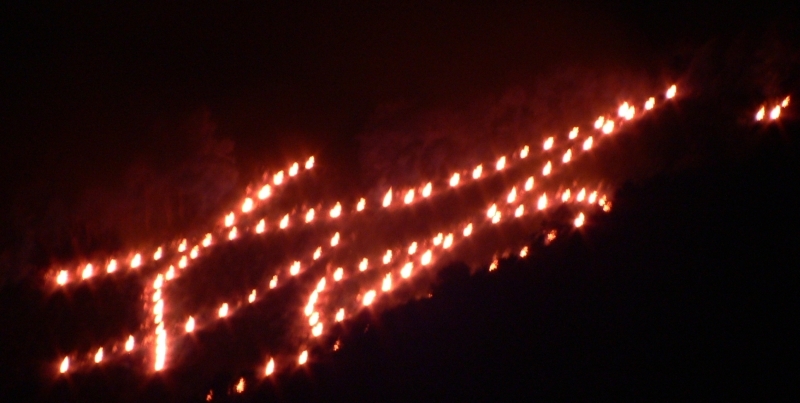
Each blaze has a particular shape, with three forming kanji characters and two showing recognizable figures. The first to be ignited at eight in the evening is Daimonji on Mount Nyoigatake, displaying the character for great. Ten minutes later, the characters Myo and Ho, which represent wondrous Buddhist teachings, appear on the Matsugasaki hills. They are followed by Funagata, a burning ship, and Hidari Daimonji, a second great character on the western peaks. Lastly, Toriigata forms the outline of a shrine gate on Mount Mandara. Lighting takes place in sequence across twenty minutes, and every fire burns for roughly half an hour.
Caretakers and origins
The exact historical beginnings of Gozan no Okuribi remain uncertain, though the ceremony is considered ancient. The massive effort needed to prepare and tend the fires rests with dedicated local lineages who hold this responsibility across generations. These families contribute extensive volunteer hours throughout the year to gather fuel, maintain the slopes, and arrange the logistics. While the scale of the fires was temporarily reduced in 2020 due to health restrictions during the pandemic, the continuity of the tradition is maintained by these hereditary groups.
Gathering to watch
On the evening of August sixteenth, onlookers assemble across the city to view the hillside illuminations. Popular viewing areas include the banks of the Kamo River, particularly between Sanjo and Imadegawa Streets, where people gather to see the earliest fires flare up against the dark. Nakagyo Ward in central Kyoto offers broad sightlines toward multiple ridges. Many local hotels also host rooftop events allowing visitors to observe several bonfires at once as the hillside silhouettes light up the summer night.
How Gozan no Okuribi is kept
Organizing families prepare the firewood and hillside plots well in advance. At eight o'clock in the evening on August sixteenth, the first fire is set alight on the eastern peak of Nyoigatake. At intervals of five to ten minutes, teams on four other mountains ignite the remaining symbols: the Buddhist phrases, a boat, a second character for greatness, and a shrine gate. By half past eight, all five shapes blaze simultaneously across the ring of hills, burning for thirty minutes before fading into darkness.
When and where
The festival takes place every year on the evening of August sixteenth. It serves as the concluding event of Obon, a season dedicated to welcoming and honouring ancestral spirits before sending them home.
Gozan no Okuribi is held on five mountains surrounding the city of Kyoto in Japan. The bonfires can be seen from open areas throughout the city, notably from the Kamo River banks and Nakagyo Ward.
What Gozan no Okuribi means
In Japanese belief, the spirits of ancestors return to visit living family members during Obon. Gozan no Okuribi translates to send-off fires, acting as beacons that light the way for these departed souls as they complete their earthly visit and journey back to the spiritual realm. The characters also reference sacred Buddhist dharma and protective shrine symbols.


Days Gozan no Okuribi is marked
Questions people ask about Gozan no Okuribi
When is Gozan no Okuribi marked?
Gozan no Okuribi is kept as part of Obon, which runs from 13 to 15 August 2027.
What is Gozan no Okuribi?
Gozan no Okuribi is a Japanese festival in Kyoto where five massive bonfires are lit on mountainsides. The blazes form characters and symbols to send departed family spirits back to the other world at the conclusion of Obon.
What shapes do the bonfires make?
Three fires form kanji characters: two meaning large or great, and one pair signifying wondrous Buddhist teachings. The other two bonfires form the shape of a boat and a shrine gate.
Who organizes and lights the fires?
The responsibility for preparing and lighting each mountain fire is passed down through specific hereditary families. These volunteers spend many hours during the year arranging the materials and keeping the tradition alive.
See also
 PretaOfferings and rites for spirits enduring deep hunger across Asian traditions.
 HiganA Japanese Buddhist week of reflection and ancestor remembrance at the equinoxes
 HalloweenAn annual observance on 31 October marking the eve of All Saints' Day, rooted in Christian tradition and Celtic heritage
 HanamiA Japanese spring custom of gathering under blooming cherry trees to eat, drink, and celebrate the fleeting beauty of th
Good reading and sources
- Gozan no Okuribi on WikipediaEncyclopedia
- More photos on Wikimedia CommonsPhotos and video
- Wikidata recordOpen data
The facts on this page come from the Wikipedia article "Gozan no Okuribi", written by its contributors and used under the CC BY-SA 4.0 licence, and from its Wikidata record (CC0). EveryParampara rewrote the text in its own words, with AI assistance, and compares every page with the article to make sure no passage is copied. It may be reused under the same CC BY-SA 4.0 licence with a link back.
It may contain mistakes. Traditions differ from one family, village and community to the next, and the people who keep them know them best. If something is wrong, tell us. Last refreshed 2026-10-04.
More from Japan
All the traditions of Japan 🇯🇵 Kyoto, JapanTorii鳥居
A traditional Japanese gate marking the entrance to a Shinto shrine and separating the sacred from the mundane.Spiritual
🇯🇵 Kyoto, JapanTorii鳥居
A traditional Japanese gate marking the entrance to a Shinto shrine and separating the sacred from the mundane.Spiritual
 🇯🇵 JapanEma絵馬
Small wooden plaques left at Japanese shrines and temples for prayers and wishes.Spiritual
🇮🇳 India and 5 morePretaप्रेत
Offerings and rites for spirits enduring deep hunger across Asian traditions.Spiritual
🇯🇵 JapanEma絵馬
Small wooden plaques left at Japanese shrines and temples for prayers and wishes.Spiritual
🇮🇳 India and 5 morePretaप्रेत
Offerings and rites for spirits enduring deep hunger across Asian traditions.Spiritual
 🇯🇵 JapanOmamori御守 (omamori)
Japanese protective amulets sold at shrines and temples for luck and safety.Spiritual
🇯🇵 JapanOmamori御守 (omamori)
Japanese protective amulets sold at shrines and temples for luck and safety.Spiritual
The same idea elsewhere
Remembering the ancestors compared
🇮🇪 Ireland and 5 moreHalloween
An annual observance on 31 October marking the eve of All Saints' Day, rooted in Christian tradition and Celtic heritageFestival · Sweets given and shared
 🇮🇳 Ayodhya, India and 7 moreDiwaliदीपावली (Dīpāvalī)
A five-day festival of lights celebrated across India and its diaspora to mark the victory of light over darkness.Festival · Feasts and festival meals
🇮🇳 Ayodhya, India and 7 moreDiwaliदीपावली (Dīpāvalī)
A five-day festival of lights celebrated across India and its diaspora to mark the victory of light over darkness.Festival · Feasts and festival meals
 🇮🇷 Iran and 7 moreNowruzنوروز
The Iranian new year at the March equinox, kept with fire, greenery and picnicsSeasonal
🇮🇷 Iran and 7 moreNowruzنوروز
The Iranian new year at the March equinox, kept with fire, greenery and picnicsSeasonal
 🇮🇱 Jerusalem, Israel and 1 moreHanukkahחֲנֻכָּה
An eight-day Jewish festival marking the rededication of the Second Temple in Jerusalem and the miracle of a single day'Festival
🇮🇱 Jerusalem, Israel and 1 moreHanukkahחֲנֻכָּה
An eight-day Jewish festival marking the rededication of the Second Temple in Jerusalem and the miracle of a single day'Festival