Dress and adornmentSoutheast Asia
Songket
In its own language: ᬲᭀᬂᬓᬾᬢ᭄
A hand-woven cloth threaded with gold or silver, worn at weddings and royal courts

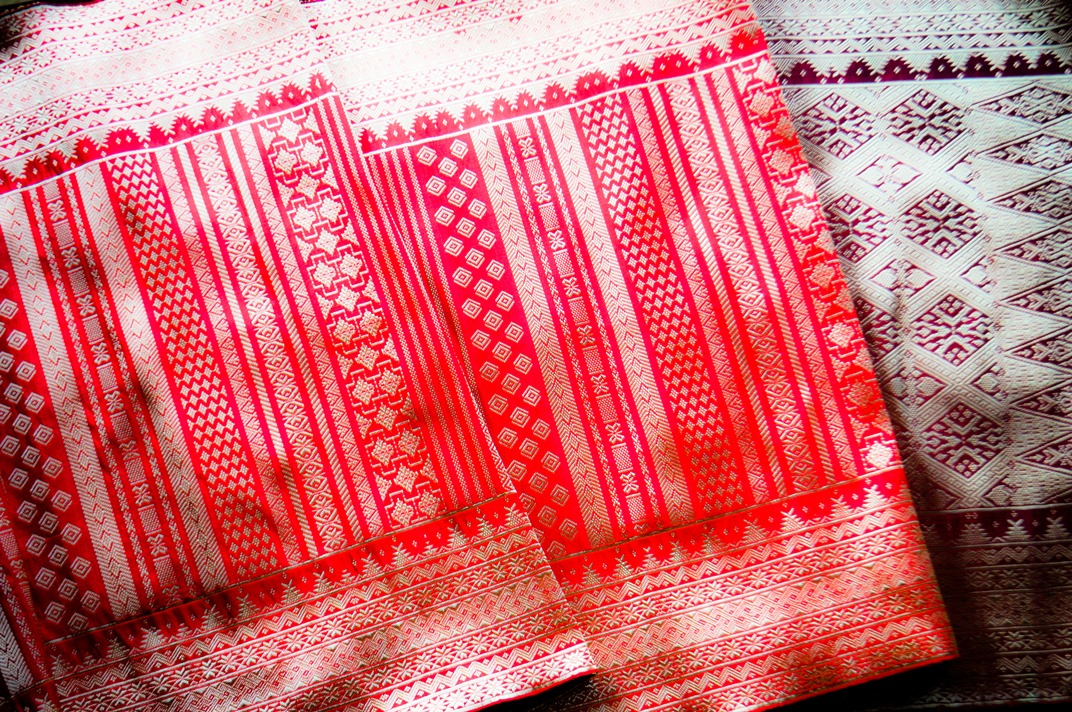
Songket is a hand-woven brocade cloth from Brunei, Indonesia and Malaysia, patterned with gold or silver thread. Linked to the Srivijaya empire and the weaving centres of Sumatra, it is worn today for weddings, festivals and court occasions, and fine pieces are kept as family heirlooms.
When is Songket kept?
Songket is kept on ceremonial occasions, such as weddings and festivals.
Songket is a cloth woven by hand from silk or cotton, with gold or silver thread worked into the pattern so that it catches the light. Weavers in Sumatra, Bali and the Malay Peninsula have made it for centuries, and it is linked above all with Palembang and the Srivijaya empire. Today it is kept for weddings, festivals, royal ceremony and family heirlooms.
The cloth itself
Songket sits in the brocade family, which means extra thread is added during weaving to build a pattern. Silk or cotton forms the base. Gold or silver thread is worked among the crosswise weft threads, a method known as supplementary weft. The metal lies above the surface, so the design stands out and seems to shine against the plainer cloth. Motifs run from small repeated shapes to long ornamental bands. A Minangkabau piece, for instance, may carry a pattern read as bamboo shoots. Thread was once wound with real gold leaf, which made the cloth costly and rare.
Origins and early records
The tradition is usually tied to Srivijaya, a wealthy trading empire based in Sumatra that ran from the 7th to the 13th century. Clothing carved on figures at the Bumiayu temple complex in South Sumatra suggests patterned cloth was known there in the 8th or 9th century. A Chinese chronicle of the Song dynasty records a Javanese envoy arriving in 992 with silk bearing floral designs in gold. Stone carving from the Hindu-Buddhist period in Java also hints at goldwork, including a star flower motif still used in songket. Early evidence remains thin and is read with care.
Courts and ceremonies
Royal households took songket into their dress. In Sumatra it was worn at the court of Srivijaya, and later by the Deli, Serdang, Palembang and Jambi royal houses; in the Malay Peninsula it is linked with the sultanates of Pattani, Kelantan and Terengganu. Brunei's court includes it in ceremonial costume, a practice that began in the reign of Sultan Omar Ali Saifuddien III. Away from the palace it belongs to weddings and religious festivals. Brides and grooms at Palembangese, Minangkabau and Balinese weddings wear it, as a sarong, a shoulder cloth, a head tie or the folded tanjak headdress.
Rank and memory
The cloth has long said something about the person wearing it. In Palembang certain motifs were reserved for bangsawan, the nobles and aristocrats, and the lepus design was among them. Widows in old Palembang wore a conspicuous selendang, or shoulder cloth, which made their position known; one motif was for a widow free to remarry, another for a widow who was a bride. Once the sultanate fell, songket moved beyond the upper class. Fine old pieces made with genuine gold thread are still treasured as pusaka, heirlooms passed down inside a family.
Today and change
Everyday songket is now woven with manufactured thread, often nylon that mimics gold, so the cloth costs far less than it once did. Genuine gold-thread pieces survive but are few. People mostly wear songket as traditional costume for weddings and ceremonies, while designers and promoters try to bring it into wider fashion. West Sumatran songket was shown in the Netherlands in colonial times. In August 2015 Sawahlunto in West Sumatra held a songket carnival with a parade and displays by weaving studios from across the province. Recognition followed: national listing in Malaysia, and UNESCO in 2021.
How Songket is kept
Women have traditionally been the weavers, though men now work at the loom as well. Making a piece means setting up silk or cotton as the base, then, row by row, lifting a group of crosswise threads and tucking gold or silver thread beneath them so the pattern grows. Pattern and colour follow local custom. The finished cloth is worn rather than displayed: tied as a sarong, draped over the shoulder, wound as a head tie, or folded into the tanjak headdress. It comes out for a wedding, a festival or a court occasion, and afterwards it is folded away or passed down in the family.
When and where
There is no single day for songket. It is worn when a ceremony calls for it: a wedding, a religious festival, a court occasion or a traditional social function. Families and hosts fix the date. Looms work through the year.
Songket belongs to Brunei, Indonesia and Malaysia. Production centres in Indonesia include Palembang in South Sumatra, the Minangkabau highlands of West Sumatra, Bali, Lombok, Sambas, Sumbawa, Makassar and Sulawesi. In Malaysia it is linked with Kelantan and Terengganu. Trade, movement and marriage also carried it around maritime Southeast Asia, including to Singapore.
What Songket means
For those who wear it, songket marks a moment as important. Gold thread once stood for wealth and rank, and a particular motif could announce who a person was: an aristocrat, a widow or a bride. The same cloth can honour a wedding or be kept as pusaka, an heirloom handed down. Its shine reads as dignity rather than display, and putting it on is a way of showing respect for the occasion and for the people gathered.



Questions people ask about Songket
When is Songket kept?
Songket is kept on ceremonial occasions, such as weddings and festivals.
What is songket?
It is a hand-woven cloth of the brocade family, made in silk or cotton and patterned with gold or silver thread. The metal thread is worked between the crosswise threads, so the design stands above the ground cloth and catches the light.
Where does it come from?
It is linked with the Srivijaya empire and with Palembang in South Sumatra. Weaving centres are found across Sumatra, Bali, Lombok, Sumbawa, Makassar and Sulawesi, and the cloth is also made and worn in Malaysia, Brunei and Singapore. Accounts of its beginnings differ and stay unclear.
Who weaves it?
By tradition the weavers are women, and in recent times men have taken up the loom too. Much work is done in home workshops, among them ones near Kota Bharu in Kelantan and in Terengganu, and in Sumatran centres such as Palembang and the Minangkabau area.
Has it been officially recognised?
Yes. Malaysia named songket intangible national heritage in 2012. Indonesia has recorded five regional songket traditions as intangible cultural heritage between 2013 and 2019, and in 2021 UNESCO placed songket on its Representative List, in an entry put forward by Malaysia.
See also
 UlosA hand-woven textile of the Batak people in Indonesia, worn for warmth and ceremony.
 Baju MelayuThe long-sleeved Malay man's shirt and trousers, formal national dress in Malaysia and Brunei
 KebayaA front-opening blouse and wrapped cloth, worn by women across Southeast Asia
 IkatA resist-dyeing craft from Southeast Asia, where yarns are tied and dyed before weaving
Good reading and sources
- Songket on WikipediaEncyclopedia
- More photos on Wikimedia CommonsPhotos and video
- Wikidata recordOpen data
The facts on this page come from the Wikipedia article "Songket", written by its contributors and used under the CC BY-SA 4.0 licence, and from its Wikidata record (CC0). EveryParampara rewrote the text in its own words, with AI assistance, and compares every page with the article to make sure no passage is copied. It may be reused under the same CC BY-SA 4.0 licence with a link back.
It may contain mistakes. Traditions differ from one family, village and community to the next, and the people who keep them know them best. If something is wrong, tell us. Last refreshed 2026-10-05.
More from Indonesia
All the traditions of Indonesia
🇮🇩 North Sumatra, IndonesiaUlosᯥᯞᯘᯬ᯲
A hand-woven textile of the Batak people in Indonesia, worn for warmth and ceremony.Dress
🇲🇾 Malacca, Malaysia and 5 moreBaju Melayuباجو ملايو
The long-sleeved Malay man's shirt and trousers, formal national dress in Malaysia and BruneiDress
🇮🇩 Yogyakarta, Indonesia and 4 moreKebayaꦏꦼꦧꦪ
A front-opening blouse and wrapped cloth, worn by women across Southeast AsiaDress
 🇮🇳 India and 5 moreBindi
A dot worn between the eyebrows, red for marriage and devotion, worn daily by many womenDress
🇮🇳 India and 5 moreBindi
A dot worn between the eyebrows, red for marriage and devotion, worn daily by many womenDress
The same idea elsewhere
Weddings compared 🇮🇷 Isfahan, Iran and 3 morePersian gardenباغ ایرانی
An ancient tradition of creating walled, geometric sanctuaries of shade and flowing waterCraft
🇮🇷 Isfahan, Iran and 3 morePersian gardenباغ ایرانی
An ancient tradition of creating walled, geometric sanctuaries of shade and flowing waterCraft
 🇸🇩 SudanJirtigالجَرْتِقْ
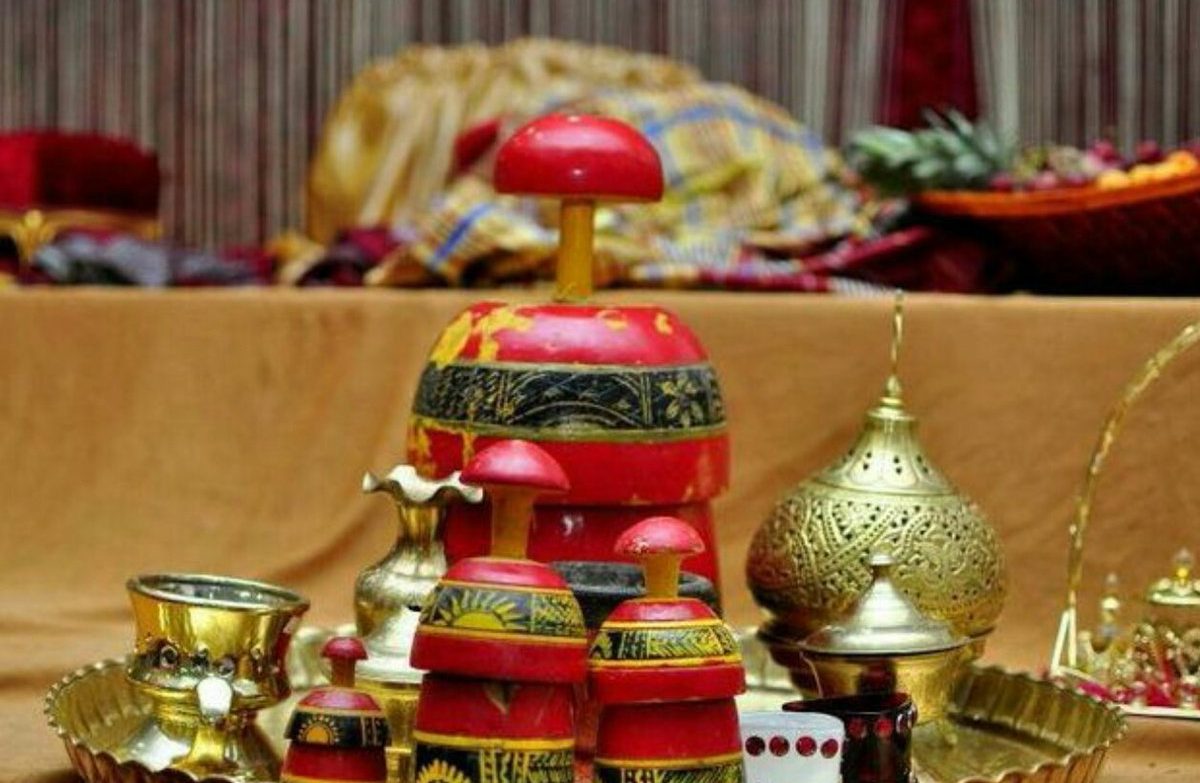
A Sudanese wedding ritual of regal adornment, protection, and blessings of fertilityRite of passage
🇸🇩 SudanJirtigالجَرْتِقْ
A Sudanese wedding ritual of regal adornment, protection, and blessings of fertilityRite of passage
 🇮🇳 Lucknow, India and 3 moreSherwani
A long buttoned coat for men, worn at weddings and state occasions in South AsiaDress
🇮🇳 Lucknow, India and 3 moreSherwani
A long buttoned coat for men, worn at weddings and state occasions in South AsiaDress
 🇹🇴 Tonga and 1 moreTaʻovala
A waist mat worn in Tonga for weddings, funerals and formal daysDress
🇹🇴 Tonga and 1 moreTaʻovala
A waist mat worn in Tonga for weddings, funerals and formal daysDress