Customs of food and drinkMiddle East
Samanu
In its own language: سمنو
A sweet sprouted-wheat paste stirred through the night for Nowruz
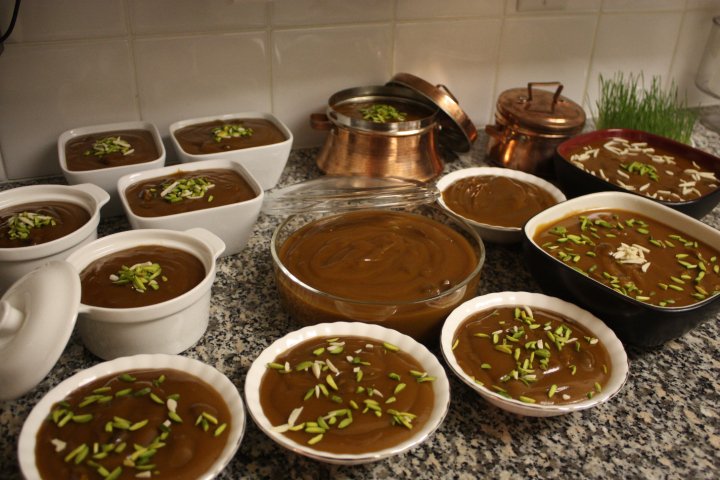
A sweet paste boiled from sprouted wheat, samanu belongs to Nowruz, the new year that opens spring. Women in Iran, Afghanistan, Tajikistan and neighbouring lands cook it in one big pot through the night, sing as they stir, and share it out warm the next morning.
When is Samanu marked?
Samanu is kept as part of Parsi New Year, which is on Sunday, 15 August 2027.
Every spring, as Nowruz comes round, households from Iran to Central Asia soak wheat until it sprouts, then boil it for hours into a sweet paste. The dish is called samanu, or sumalak, or samanak, depending on where you are. It counts among the seven things set out on the Nowruz table, and it takes a whole night of stirring, singing and wishing to make.
A sweet wheat paste
Samanu is thick and sweet. Wheat is soaked and allowed to sprout first, then boiled down in a big pot of the kind called a kazan. One dish, many names: samanak in Persian, sumalak in Uzbek, sümelek in Turkmen and Kazakh, sumanak in Tajik, sümölök in Kyrgyz, səməni halvası in Azerbaijani. At Nowruz it takes its place among the seven symbolic items known as the Haft-Sin. In Afghanistan it is also eaten at mela, which are picnics.
Origins and history
The custom is usually traced to the Sasanian Persian Empire, which ruled in the region before Islam arrived. How the dish first appeared is not recorded. What is clear is that the practice outlived that empire, stayed attached to the spring new year, and picked up a different name in each language it passed through. In 2025 the cooking culture of sumanak and sumalak, put forward by Tajikistan, was added to UNESCO's representative list of intangible cultural heritage.
Songs and wishes
The night is not quiet. Women sing songs about the making of samanu while the pot bubbles. In Tajikistan and Afghanistan a favourite line tells of the samanak boiling as they stir it, and of everyone else asleep while they play the daf, a frame drum. Each woman waits her turn at the spoon, and a stir is a good moment to ask for something. Near the end, whole walnuts go in, one wish each. Laughter and music belong to the night as much as the wheat does.
Today and change
In many homes the cooking has become a family activity. The old method used sprouted wheat and water alone. Cooks today often stir in a little flour so the paste thickens sooner, which makes it slightly bitter and less sweet. In Iran, buying and selling samanu in the closing days of the year has grown into a seasonal trade. It is based in Ashtian, from where the paste is sent on to European, Arab and East Asian countries.
How Samanu is kept
The wheat is soaked and left to sprout for several days, so the whole job can stretch to a week. The last stage is the long one: the pot goes on in the evening and the boiling runs until daylight. In the Iranian way the women sit in a circle round the pot, take turns with the spoon, sing and enjoy themselves. Wishes are made while stirring, and whole walnuts go in near the end, again with a wish. In the morning the paste is warm when it goes to the neighbours, to relatives and to friends.
When and where
It belongs to Nowruz, the new year at the beginning of spring. In Iran the cooking happens in the last days of the year, once the wheat has sprouted. The final boil takes a whole night, and the sharing comes at dawn, so the paste is ready for the holiday itself.
The paste is made in Iran, Afghanistan, Tajikistan and Azerbaijan, and further away in Turkmenistan, Uzbekistan, Kyrgyzstan and Kazakhstan. In Afghanistan it is also eaten at mela, which are picnics. In Iran, buying and selling it in the last days of the year is a seasonal trade based in Ashtian, which sends it to Europe, Arab countries and East Asia.
What Samanu means
Samanu is one of the seven items set out at Nowruz, so it stands for the season itself: wheat waking up, the year turning, sweetness at the start. The long night of stirring carries meaning too. Each turn of the spoon is a moment to ask for something, and the walnuts go in with wishes of their own. Sharing the warm paste in the morning turns private hopes into something held in common.


Days Samanu is marked
Questions people ask about Samanu
When is Samanu marked?
Samanu is kept as part of Parsi New Year, which is on Sunday, 15 August 2027.
What is samanu?
A sweet paste made from wheat that has been soaked until it sprouts. Older recipes used the sprouted wheat and water alone. Many cooks today add a little wheat flour to thicken it faster, which makes the paste taste a bit bitter and less sweet.
Who does the cooking?
Traditionally women, who gather round one large pot, sit in a circle, sing songs about samanu and take turns stirring. A wish can go with each turn, and whole walnuts are added near the end. Nowadays it is often a family activity.
Where is it kept?
In Iran, Afghanistan, Tajikistan and Azerbaijan, and across Central Asia, where it also answers to sumalak, sümelek, sumanak and sümölök. In Iran the selling of it is a seasonal trade based in the city of Ashtian.
What happens to it in the morning?
By then it is still warm, and portions go to the neighbours, to relatives and to friends. That sharing is part of the custom: what was cooked together through the night is given away at dawn.
See also
 Armudu tea glassA pear-shaped glass used in Azerbaijan to serve and drink black tea.
 SamovarA heated urn that brews tea for a slow, sociable pour, from Russia to Iran and Kashmir
 IftarThe sunset meal that breaks the Ramadan fast, eaten with family and community
 Butter teaA salted tea churned with yak butter, served to guests across the Himalaya
Good reading and sources
- BBC PersianBBC, Article
- Culture of Sumanak/Sumalak cookingUNESCO, Heritage listing
- BBC PersianBBC, Article
- Culture of Sumanak/Sumalak cookingUNESCO, Article
- Samanu on WikipediaEncyclopedia
- More photos on Wikimedia CommonsPhotos and video
- Wikidata recordOpen data
The facts on this page come from the Wikipedia article "Samanu", written by its contributors and used under the CC BY-SA 4.0 licence, and from its Wikidata record (CC0). EveryParampara rewrote the text in its own words, with AI assistance, and compares every page with the article to make sure no passage is copied. It may be reused under the same CC BY-SA 4.0 licence with a link back.
It may contain mistakes. Traditions differ from one family, village and community to the next, and the people who keep them know them best. If something is wrong, tell us. Last refreshed 2026-10-05.
More from Iran
All the traditions of Iran
🇷🇺 Tula, Russia and 3 moreSamovarсамовар
A heated urn that brews tea for a slow, sociable pour, from Russia to Iran and KashmirTable custom · Tea, coffee and drinking ceremonies
🇮🇷 Mashhad, Iran and 7 moreIftarإفطار
The sunset meal that breaks the Ramadan fast, eaten with family and communityTable custom · Fasting and breaking the fast
 🇮🇷 Iran and 7 moreNowruzنوروز
The Iranian new year at the March equinox, kept with fire, greenery and picnicsSeasonal
🇮🇷 Iran and 7 moreNowruzنوروز
The Iranian new year at the March equinox, kept with fire, greenery and picnicsSeasonal
 🇮🇱 Jerusalem, Israel and 1 morePurimפּוּרִים
A lively Jewish festival of storytelling, shared food, masks and charityFestival · Feasts and festival meals
🇮🇱 Jerusalem, Israel and 1 morePurimפּוּרִים
A lively Jewish festival of storytelling, shared food, masks and charityFestival · Feasts and festival meals
The same idea elsewhere
New Year compared 🇲🇳 Mongolia and 2 moreTsagaan SarЦагаан сар
The Mongolian Lunar New Year festival of peace, elders, white foods and renewalSeasonal · Feasts and festival meals
🇲🇳 Mongolia and 2 moreTsagaan SarЦагаан сар
The Mongolian Lunar New Year festival of peace, elders, white foods and renewalSeasonal · Feasts and festival meals
 🇦🇿 AzerbaijanNovruzNovruz Bayramı
The Azerbaijani spring equinox festival of bonfires, sweets and sprouted wheatSeasonal · Feasts and festival meals
🇦🇿 AzerbaijanNovruzNovruz Bayramı
The Azerbaijani spring equinox festival of bonfires, sweets and sprouted wheatSeasonal · Feasts and festival meals
 🇮🇳 Guwahati, IndiaBohag Bihu
A multi-day Assamese New Year festival of cattle rites, music, gifts and feastsSeasonal · Feasts and festival meals
🇮🇳 Guwahati, IndiaBohag Bihu
A multi-day Assamese New Year festival of cattle rites, music, gifts and feastsSeasonal · Feasts and festival meals
 🇻🇳 VietnamTếtTết Nguyên Đán
The Vietnamese festival of the lunar new year, welcoming spring with family gatheringsFestival · Feasts and festival meals
🇻🇳 VietnamTếtTết Nguyên Đán
The Vietnamese festival of the lunar new year, welcoming spring with family gatheringsFestival · Feasts and festival meals