Festivals and celebrationsMiddle EastZoroastrian
Yaldā Night
In its own language: شب یلدا
A solstice night of poetry, fruit and family, kept from Iran through Central Asia

Yaldā Night, also called Chilla Night, falls on the December solstice, when daylight is at its shortest in the Northern Hemisphere. Families across Iran and neighbouring countries stay up late over dinner, fruit and nuts and read poetry aloud until after midnight; UNESCO listed the custom in 2022.
When is Yaldā Night in 2026?
Yaldā Night 2026 is on Monday, 21 December 2026. Other years: 2027, Tuesday, 21 December 2027; 2028, Wednesday, 20 December 2028.
On the day of the year with the least daylight, families in Iran and the lands around it sit up late together. Yaldā Night, also called Chilla Night, is a winter festival of company, food and poetry. People share fruit and nuts, read Hafez aloud and tell stories past midnight, keeping a custom written into Iran's official calendar more than two thousand years ago.
What it is
Yaldā Night is the closing night of autumn in the Iranian solar calendar. It sits between the last day of Azar, the ninth month, and the first day of Dey, the tenth. In the Gregorian calendar that is 21 December, or 20 December in a leap year. It is kept in Iran, Afghanistan, Tajikistan, Uzbekistan, Azerbaijan, Turkmenistan and Kurdistan. The night opens winter and the first of the two winter Chilla periods, spans of forty days and nights that also give the feast its other name. Homes fill with relatives and friends who stay up together, eat, talk and recite poetry.
The names it carries
Persian speakers say Shab-e Yalda, and also Shab-e Chilla, and the two are used side by side. Chilla means fortieth, a reference to the forty-day run of winter that begins on this night. The word Yaldā reached Persian by another route: it belongs to Syriac, a Middle Aramaic dialect, where it meant birth and served Christians as a name for Christmas. Eastern Christians under Parthian and Sasanian rule kept that feast on the eve of the solstice, nine months after the Annunciation. Their non-Christian neighbours picked up the term, and it settled into the language at a date nobody can now fix.
Origins and history
According to the sources, this night stood in Iran's official calendar in Achaemenid times, from at least 502 BCE under Darius I, and many customs have survived from then. Zoroastrians treated the long December night as a dangerous stretch, when the forces of Ahriman were thought to be strongest, so people kept each other company and stayed awake. Al-Biruni, writing in the tenth century, recorded that the following day was celebrated as Ḵorram-ruz, the joyful day. A modern researcher, Zana Salehrad, traces the feast to solar rites older than Zoroastrianism that welcomed the sun's return. A link with Mithra is often repeated online, but current scholarship does not accept it.
How it is kept
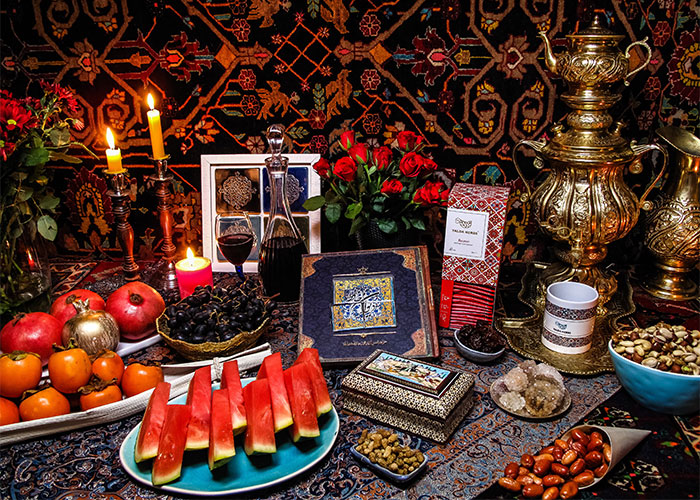
Guests arrive before dark and the gathering runs long past midnight. A full dinner comes first, with fruit, nuts and sweetmeats kept back for the occasion, often laid out on a korsi, the low covered table that people sit around in winter. Afterwards the older members of the family tell stories and jokes. Some sing and some dance. Poetry is read aloud, above all Hafez, and many households open his Divan for fāl, divination by a random page. Dried fruit and nuts are handed out as gifts, and in Khorasan a bride receives a present as a matter of custom.
Food, fruit and belief
Two fruits hold the place of honour. Pomegranate and watermelon are kept for this night and given a special place at the table, and the red of their flesh is read as a sign of the coming dawn and of life. Some families aim to set out forty kinds of food. Beliefs cluster around what is eaten: watermelon is said to keep a person well through the heat of the following summer, and in Khorasan carrots, pears, pomegranates and green olives are thought to ward off insect bites, especially from scorpions, while garlic is eaten against aching joints. In Khorasan, too, families make kafbikh, a local sweet, most notably in Gonabad and Birjand.
How Yaldā Night is kept
Extended family and friends gather at one house before nightfall. Dinner is served, usually a full meal with fruit, nuts and sweetmeats on the table or around the korsi. Then the talking begins: poems recited from Hafez and the Shahnameh, jokes, memories, stories from the older people, sometimes music and dancing. Some open the Divan of Hafez for divination, no more than three times. Guests stay awake until after midnight, and dried fruit and nuts are handed out as gifts. In Khorasan the family also makes kafbikh, and a gift for the bride is customary.
When and where
It is kept on one night each year, the night of the December solstice. In the Gregorian calendar that is 21 December, or 20 December when the year is a leap year. In the Iranian solar calendar it is the night between the last day of Azar and the first day of Dey.
The night is kept in Iran, Afghanistan, Tajikistan, Uzbekistan, Azerbaijan and Turkmenistan, and among Kurdish families in Kurdistan. Iran is its main home, and the customs are strongest where extended families gather in the same house. UNESCO added it to its Intangible Cultural Heritage list in 2022.
What Yaldā Night means
Yaldā marks the turn from shortening days to lengthening ones, so the night carries the idea of light returning. The red of pomegranate and watermelon stands for the flush of dawn and for life. Staying awake is the old protective custom: the dark hours were once thought to belong to harmful forces, and company kept them at bay. Today the meaning is quieter and social. Zana Salehrad sees the feast as proof that cultural memory travels across generations while the shape of the party changes.
On the table
Flavours: Garlic


Yaldā Night dates: 2026, 2027, 2028
| Year | Yaldā Night date |
|---|---|
| 2026 | Monday, 21 December 2026 |
| 2027 | Tuesday, 21 December 2027 |
| 2028 | Wednesday, 20 December 2028 |
Questions people ask about Yaldā Night
When is Yaldā Night in 2026?
Yaldā Night 2026 is on Monday, 21 December 2026. Other years: 2027, Tuesday, 21 December 2027; 2028, Wednesday, 20 December 2028.
What is Yaldā Night?
It is a winter festival kept on the December solstice, the night when daylight is shortest in the Northern Hemisphere. Families gather for a late dinner, share fruit and nuts and read poetry, especially Hafez, until after midnight. Its other name is Chilla Night.
Where is it kept?
In Iran, its main home, and in Afghanistan, Tajikistan, Uzbekistan, Azerbaijan and Turkmenistan, and among Kurdish families in Kurdistan. In 2022 UNESCO added Yaldā and Chilla to its Intangible Cultural Heritage list, on a nomination from Iran and Afghanistan.
Why do people stay up so late?
Zoroastrians held the deep dark of that night to be an inauspicious time, when harmful forces were at their strongest, so families gathered in numbers and no one slept alone. The religious fear has gone, but staying up late in company has stayed.
What is fāl-e Hafez?
It is divination with the Divan of Hafez, his collected poems. Someone opens the book at a random page and reads the verse as an answer to a question. People do this at Yalda and on other occasions, and it is said that asking more than three times will annoy the poet.
See also
 Sizdah BedarAn open-air picnic holiday concluding the Iranian New Year celebrations
 SadehAn ancient midwinter festival of fire, light, and the approach of spring
 Novy GodA secular winter celebration of decorated trees, family feasts and midnight gifts
 Georgian polyphonic singingSeveral voices at once, sung without instruments at Georgian feasts and weddings
Good reading and sources
- Yalda Night on WikipediaEncyclopedia
- More photos on Wikimedia CommonsPhotos and video
- Wikidata recordOpen data
The facts on this page come from the Wikipedia article "Yalda Night", written by its contributors and used under the CC BY-SA 4.0 licence, and from its Wikidata record (CC0). EveryParampara rewrote the text in its own words, with AI assistance, and compares every page with the article to make sure no passage is copied. It may be reused under the same CC BY-SA 4.0 licence with a link back.
It may contain mistakes. Traditions differ from one family, village and community to the next, and the people who keep them know them best. If something is wrong, tell us. Last refreshed 2026-10-09.
More from Iran
All the traditions of Iran
🇮🇷 Iran and 4 moreSizdah Bedarسیزدهبدر
An open-air picnic holiday concluding the Iranian New Year celebrationsFestival
🇮🇷 Yazd, Iran and 1 moreSadehسده
An ancient midwinter festival of fire, light, and the approach of springFestival · Feasts and festival meals
 🇮🇱 Jerusalem, Israel and 1 morePurimפּוּרִים
A lively Jewish festival of storytelling, shared food, masks and charityFestival · Feasts and festival meals
🇮🇷 Iran and 2 moreKhordad Salخرداد روز
A Zoroastrian festival marking the birth of the prophet Zarathushtra with prayers and feasts.Festival · Feasts and festival meals
🇮🇱 Jerusalem, Israel and 1 morePurimפּוּרִים
A lively Jewish festival of storytelling, shared food, masks and charityFestival · Feasts and festival meals
🇮🇷 Iran and 2 moreKhordad Salخرداد روز
A Zoroastrian festival marking the birth of the prophet Zarathushtra with prayers and feasts.Festival · Feasts and festival meals
The same idea elsewhere
Midwinter and the longest night compared 🇩🇪 Germany and 5 moreChristmas tree
A decorated evergreen or artificial tree placed indoors to mark the Christmas season.Festival
🇩🇪 Germany and 5 moreChristmas tree
A decorated evergreen or artificial tree placed indoors to mark the Christmas season.Festival
 🇫🇷 France and 5 moreCandlemas
A Christian feast of candle blessings marking the end of the Christmas seasonSpiritual
🇫🇷 France and 5 moreCandlemas
A Christian feast of candle blessings marking the end of the Christmas seasonSpiritual
 🇨🇳 Shanghai, China and 1 moreJiaozi餃子
Crescent Chinese dumplings filled with meat or vegetables, eaten for fortune and feastsTable custom · Breakfast
🇨🇳 Shanghai, China and 1 moreJiaozi餃子
Crescent Chinese dumplings filled with meat or vegetables, eaten for fortune and feastsTable custom · Breakfast
 🇬🇧 United Kingdom and 5 moreYule log
A log kept burning on the hearth through the twelve days of Christmas, for luckSeasonal
🇬🇧 United Kingdom and 5 moreYule log
A log kept burning on the hearth through the twelve days of Christmas, for luckSeasonal