🇹🇲 Traditions of Turkmenistan
8 traditions from Turkmenistan, best known first, across 1 city and town.
Turkmen traditions are rooted in a nomadic heritage of horse breeding and clan identity, now expressed through distinctive dress and carpet weaving. The calendar blends Islamic observances with state holidays celebrating national symbols and harvests.
The Turkmen people maintain a culture shaped by centuries of pastoral life and tribal loyalty. Today, this legacy appears in the elaborate carpets that mark clan affiliation, the sheepskin hats worn by men, and the long robes favored by women. Their year turns on religious festivals like Uraza Bayram and Nowruz, alongside modern celebrations of neutrality and independence. Horse breeding remains a central pride, linking past equestrian skills to present-day rituals.
The year and its festivals
The Turkmen calendar mixes Islamic rites with civic commemorations. Nowruz marks the spring equinox in late March, welcoming the new solar year with family gatherings. Religious observances include Uraza Bayram, which ends the fasting month of Ramadan, and Kurban Bayram, a festival of sacrifice celebrated in the tenth month of the Islamic lunar calendar. Both dates shift annually and are set by presidential decree. State holidays anchor the civic year. Independence Day falls on September 27, while Day of Neutrality is observed on December 12. Spring also brings the Turkmen Carpet Day in May and the Racing Horse Festival in April, honoring two pillars of national identity. The wheat harvest is marked by Galla Bayramy in July, a rural celebration of agricultural abundance.
Faith and ritual
Most Turkens follow Sunni Islam, though small communities practice Christianity or retain older folk beliefs. Religious leaders, known as Akhun, wear white shirts without embroidery and high collars. Ritual life centers on the major Islamic holidays mentioned above. These occasions bring families together for prayer, feasting, and charity. The community respects the clergy and their traditional attire. Outside of formal religion, oral literature preserves ancient values. Poets like Magtymguly Pyragy and Mämmetweli Kemine are revered figures whose works shape moral understanding. Fairy tales, called Ertekiler, pass down wisdom and history through generations.
Dress and identity
Clothing signals clan membership and social role. Men traditionally wear a koynek, a white shirt with embroidered collars, paired with wide trousers called balak. The most common collar style today is Chak yaka. Over this, they don a don, a silk robe often dyed red using pomegranate or walnut husks. The telpek, a large sheepskin hat, is the most recognizable male accessory. Women wear floor-length koynek dresses, sometimes layered with a chabyt in formal settings. Married women may cover their heads with a yalyk or silver jewelry. Traditional pants are less common among youth, who prefer Western styles. Ceremonial garments are treated with care to preserve their quality and meaning.
The table and what is eaten when
The sources do not provide specific details on daily meals or regional dishes. They mention natural dyes from pomegranate and walnuts but do not describe culinary practices. Therefore, no section on food can be written based on the provided text.
Arts and crafts
Carpet weaving is a defining art form. Turkmen rugs are hand-knotted and feature intricate patterns that distinguish one clan from another. These textiles are often mislabeled as Bukhara rugs in foreign markets. Music shares similarities with Khorasani styles, reflecting regional connections. Theatre exists in ten state venues across the capital and regions. Literature relies on oral tradition and poetry. The Bakhshi Day honors storytellers and musicians who keep epic narratives alive. These arts serve as records of history and markers of cultural pride.
The facts in this overview come from the Wikipedia article "Culture of Turkmenistan", written by its contributors and used under the CC BY-SA 4.0 licence. EveryParampara rewrote the text in its own words, with AI assistance, and compares every page with the article to make sure no passage is copied. It may be reused under the same CC BY-SA 4.0 licence with a link back.
The table in Turkmenistan
Foods and drinks by the moment they belong to.
| Dinner | Yaldā Night |
|---|---|
| Sweets given and shared | Yaldā Night, Samanu |
| Feasts and festival meals | Yaldā Night, Beshbarmak |
Cities, towns and villages of Turkmenistan
 🇹🇲 Ashgabat, Turkmenistan and 2 moreTurkmen rugTürkmen haly
Handmade textiles woven by Turkmen tribes, featuring geometric patterns and natural dyes.Craft
🇹🇲 Ashgabat, Turkmenistan and 2 moreTurkmen rugTürkmen haly
Handmade textiles woven by Turkmen tribes, featuring geometric patterns and natural dyes.Craft
 🇮🇷 Iran and 5 moreYaldā Nightشب یلدا
A solstice night of poetry, fruit and family, kept from Iran through Central AsiaFestival · Dinner
🇮🇷 Iran and 5 moreYaldā Nightشب یلدا
A solstice night of poetry, fruit and family, kept from Iran through Central AsiaFestival · Dinner
 🇷🇺 Moscow, Russia and 5 moreDefender of the Fatherland DayДень защитника Отечества
A national holiday honouring military service and male relatives, observed across several post-Soviet states.Festival
🇷🇺 Moscow, Russia and 5 moreDefender of the Fatherland DayДень защитника Отечества
A national holiday honouring military service and male relatives, observed across several post-Soviet states.Festival
 🇹🇲 Ashgabat, TurkmenistanMelon Day
A nationwide summer holiday in Turkmenistan honoring the country's prized melonsTable custom
🇹🇲 Ashgabat, TurkmenistanMelon Day
A nationwide summer holiday in Turkmenistan honoring the country's prized melonsTable custom
 🇮🇷 Iran and 5 moreDutarدوتار
A long-necked lute crafted from wood and played across Iran and Central AsiaPerformance
🇮🇷 Iran and 5 moreDutarدوتار
A long-necked lute crafted from wood and played across Iran and Central AsiaPerformance
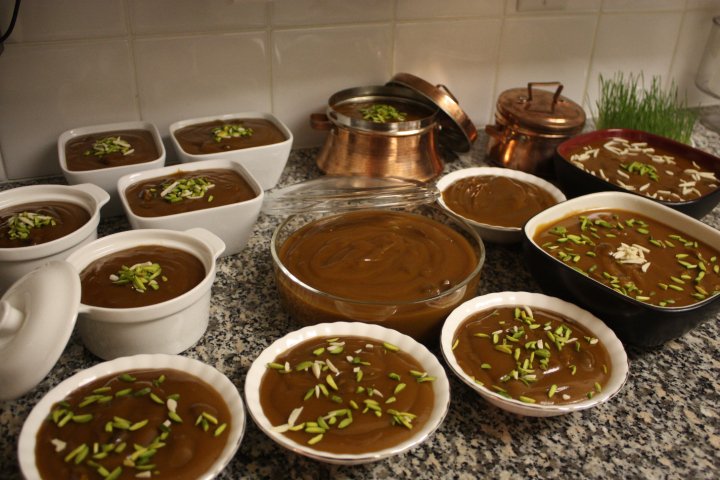 🇮🇷 Ashtian, Iran and 5 moreSamanuسمنو
A sweet sprouted-wheat paste stirred through the night for NowruzTable custom · Sweets given and shared
🇮🇷 Ashtian, Iran and 5 moreSamanuسمنو
A sweet sprouted-wheat paste stirred through the night for NowruzTable custom · Sweets given and shared
 🇰🇬 Kyrgyzstan and 4 moreBeshbarmakбешбармак
Boiled meat and noodles, eaten by hand from one platter, with a set cut for each guestTable custom · Feasts and festival meals
🇰🇬 Kyrgyzstan and 4 moreBeshbarmakбешбармак
Boiled meat and noodles, eaten by hand from one platter, with a set cut for each guestTable custom · Feasts and festival meals
 🇹🇷 Turkey and 3 moreYashmakyaşmak
A traditional face and head veil worn in Turkey, Egypt and TurkmenistanDress
🇹🇷 Turkey and 3 moreYashmakyaşmak
A traditional face and head veil worn in Turkey, Egypt and TurkmenistanDress
Photo credits on this page
The small pictures above come from Wikimedia Commons under free licences. Some are cropped to fit.
- Defender of the Fatherland Day: И. Мартынов, Public domain, source
- Melon Day: AltynAsyr, CC BY-SA 3.0, source
- Dutar: Yuet Man Lee, CC BY-SA 4.0, source
- Turkmen rug: AltynAsyr, CC BY-SA 3.0, source
- Samanu: Myone63, CC BY-SA 3.0, source
- Beshbarmak: NataAllice, CC BY-SA 4.0, source
- Yaldā Night: M.Sadegh Nikgostar/Tasnim News Agency, CC BY 4.0, source
- Yashmak: Jean-Léon Gérôme, Public domain, source