🇹🇯 Traditions of Tajikistan
13 traditions from Tajikistan, best known first, across 1 city and town.
Tajik cultural life is rooted in deep Persian history, mountain landscapes, and close community ties. Communal meals of plov and qurutob bring families together, while the spring celebration of Navruz marks the agricultural cycle with ancient customs. Needlework traditions and regional musical forms preserve living artistic expressions across valleys and highlands.
Across the high mountain ranges and river valleys of Tajikistan, daily life revolves around hospitality, shared food, and seasonal renewal. Families gather in teahouses over steaming pots of green tea or share celebratory rice dishes from single platters. From ancient spring rites to the rhythmic stitching of colorful Chakan embroidery, Tajik traditions celebrate community fellowship, domestic warmth, and respect for the bounty of the land.
The spring new year
Navruz, meaning 'New Day', arrives around the March equinox to welcome the planting season. Families prepare for the coming year by thoroughly cleaning their homes, throwing away worn goods, and visiting relatives. Communities gather for outdoor games and prepare seasonal dishes like samanu. While the festival has roots stretching before the Islamic period, some highland areas preserve even older customs linked to ancient Persian beliefs. In these remote mountain settlements, people light bonfires, dance around the hearth, leap across flames, and use fire to drive away harmful spirits. These festivities link the annual agricultural cycle directly to community renewal and hospitality.
The sacred loaf
Flatbread, known locally as non, forms the spiritual and practical foundation of every Tajik meal. People say they have no food at all if there is no bread on the table. A strict etiquette surrounds the loaf: according to tradition, placing non upside down or resting objects on top invites misfortune. When a piece falls to the ground, diners lift it gently onto a high wall or ledge for birds and passers-by. Tea accompanies every gathering, served unsweetened or with sugar in handleless bowls called piola. The local teahouse, or choykhona, serves as the neighborhood hub where neighbors meet to rest, talk, and share endless pots of green tea.
Feasting from shared platters
Hospitality culminates in large communal platters placed at the center of the gathering, where diners often eat together using their hands. The national dish is plov, also called osh, made by simmering rice with cubed meat and strips of yellow or orange carrots inside a large cauldron called a deg. Another beloved specialty, particularly in the south, is qurutob. Cooks soften flaky fatir pastry in water mixed with crushed salty cheese balls, then top the bread with sizzling fried onions and fresh herbs. A full feast opens with dried fruits, nuts, and dairy spreads, followed by savory broth or filled sambusa pastries, and concludes with fragrant plov.
Chakan needlework and weddings
Chakan is an embroidery tradition where women stitch symbols of the cosmos, nature, and ancient myths onto cotton and silk using bright thread. These embroidered panels decorate home interiors on wall hangings, bedspreads, and cushion covers, but they are most visible during festive celebrations and weddings. A bride wears an embroidered Chakan tunic, while the groom dons a matching needlework skullcap called a tāqi. Women produce these textiles individually or gather in communal workrooms under the guidance of a senior craftswoman. Mothers instruct their daughters, and seasoned makers train apprentices through the ustod-shogird tradition, passing needlework skills and design knowledge across generations of makers.
Regional musical styles
Musical styles in Tajikistan reflect the geographical divide between the highland communities and the metropolitan valleys. Shashmaqam represents the classical modal folk tradition shared across urban centers. In the southern regions, singers and instrumentalists favor falak, an expressive folk style with deep regional roots. Further east, the Pamiri people living in the high valleys of Gorno-Badakhshan cultivate their own distinct vocal and instrumental heritage. Whether played on long-necked lutes or sung during private gatherings and public feasts, these regional styles reflect local identity across the country's diverse landscapes.
The facts in this overview come from the Wikipedia article "Culture of Tajikistan", written by its contributors and used under the CC BY-SA 4.0 licence. EveryParampara rewrote the text in its own words, with AI assistance, and compares every page with the article to make sure no passage is copied. It may be reused under the same CC BY-SA 4.0 licence with a link back.
The table in Tajikistan
Foods and drinks by the moment they belong to.
| Dinner | Yaldā Night, Chaharshanbe Suri, Novy God |
|---|---|
| Tea-time and snacking customs | Chaharshanbe Suri |
| Sweets given and shared | Yaldā Night, Samanu |
| Feasts and festival meals | Yaldā Night, Sadeh, Tirgan, Novy God |
Cities, towns and villages of Tajikistan
 🇮🇷 Iran and 5 moreYaldā Nightشب یلدا
A solstice night of poetry, fruit and family, kept from Iran through Central AsiaFestival · Dinner
🇮🇷 Iran and 5 moreYaldā Nightشب یلدا
A solstice night of poetry, fruit and family, kept from Iran through Central AsiaFestival · Dinner
 🇷🇺 Moscow, Russia and 5 moreDefender of the Fatherland DayДень защитника Отечества
A national holiday honouring military service and male relatives, observed across several post-Soviet states.Festival
🇷🇺 Moscow, Russia and 5 moreDefender of the Fatherland DayДень защитника Отечества
A national holiday honouring military service and male relatives, observed across several post-Soviet states.Festival
 🇮🇷 Isfahan, Iran and 4 moreChaharshanbe Suriچهارشنبهسوری
An Iranian festival of fire and renewal celebrated on the eve of the final Wednesday before spring.Festival · Tea-time and snacking customs
🇮🇷 Isfahan, Iran and 4 moreChaharshanbe Suriچهارشنبهسوری
An Iranian festival of fire and renewal celebrated on the eve of the final Wednesday before spring.Festival · Tea-time and snacking customs
 🇮🇷 Isfahan, Iran and 4 moreMehreganمهرگان
An Iranian autumn festival honoring Mithra, friendship, and the harvestSeasonal
🇮🇷 Isfahan, Iran and 4 moreMehreganمهرگان
An Iranian autumn festival honoring Mithra, friendship, and the harvestSeasonal
 🇮🇷 Iran and 3 moreChovganچوگان
An equestrian team sport played with mallets and horses across Iran and AzerbaijanGame
🇮🇷 Iran and 3 moreChovganچوگان
An equestrian team sport played with mallets and horses across Iran and AzerbaijanGame
 🇮🇷 Amol, Iran and 3 moreTirganتیرگان (Tirgān)
An ancient Iranian summer festival of water, poetry and rainbow bands, kept on the thirteenth day of Tir.Festival · Feasts and festival meals
🇮🇷 Amol, Iran and 3 moreTirganتیرگان (Tirgān)
An ancient Iranian summer festival of water, poetry and rainbow bands, kept on the thirteenth day of Tir.Festival · Feasts and festival meals
 🇮🇷 Yazd, Iran and 1 moreSadehسده
An ancient midwinter festival of fire, light, and the approach of springFestival · Feasts and festival meals
🇮🇷 Yazd, Iran and 1 moreSadehسده
An ancient midwinter festival of fire, light, and the approach of springFestival · Feasts and festival meals
 🇮🇷 Iran and 4 moreZardoziزردوزی (zarduzi)
Heavy gold and silver embroidery on silk or velvet, worked in Iran, India and beyondCraft
🇮🇷 Iran and 4 moreZardoziزردوزی (zarduzi)
Heavy gold and silver embroidery on silk or velvet, worked in Iran, India and beyondCraft
 🇺🇿 Bukhara, Uzbekistan and 2 moreShashmaqamШашмақом
A classical song cycle of Central Asia, built on six modes and Sufi love poetryPerformance
🇺🇿 Bukhara, Uzbekistan and 2 moreShashmaqamШашмақом
A classical song cycle of Central Asia, built on six modes and Sufi love poetryPerformance
 🇷🇺 Moscow, Russia and 5 moreNovy GodНовый Год
A secular winter celebration of decorated trees, family feasts and midnight giftsFestival · Feasts and festival meals
🇷🇺 Moscow, Russia and 5 moreNovy GodНовый Год
A secular winter celebration of decorated trees, family feasts and midnight giftsFestival · Feasts and festival meals
 🇮🇷 Iran and 5 moreDutarدوتار
A long-necked lute crafted from wood and played across Iran and Central AsiaPerformance
🇮🇷 Iran and 5 moreDutarدوتار
A long-necked lute crafted from wood and played across Iran and Central AsiaPerformance
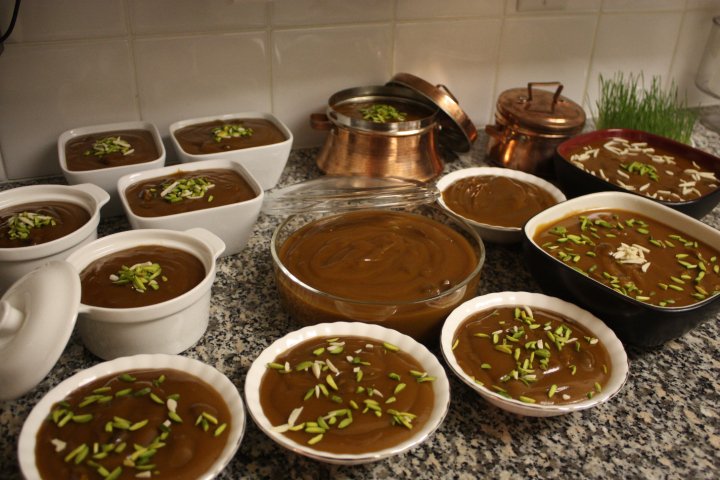 🇮🇷 Ashtian, Iran and 5 moreSamanuسمنو
A sweet sprouted-wheat paste stirred through the night for NowruzTable custom · Sweets given and shared
🇮🇷 Ashtian, Iran and 5 moreSamanuسمنو
A sweet sprouted-wheat paste stirred through the night for NowruzTable custom · Sweets given and shared
 🇮🇷 Iran and 5 moreFatimiyyaفاطمیة
A Shia period of mourning honoring the life and martyrdom of Lady FatimahSpiritual
🇮🇷 Iran and 5 moreFatimiyyaفاطمیة
A Shia period of mourning honoring the life and martyrdom of Lady FatimahSpiritual
Photo credits on this page
The small pictures above come from Wikimedia Commons under free licences. Some are cropped to fit.
- Defender of the Fatherland Day: И. Мартынов, Public domain, source
- Chaharshanbe Suri: Philippe Giabbanelli, CC BY 3.0, source
- Mehregan: PersianDutchNetwork, CC BY-SA 3.0, source
- Chovgan: en:User:Arad, CC BY-SA 3.0, source
- Zardozi: Zarood, CC BY-SA 3.0, source
- Sadeh: Farzad j, Public domain, source
- Tirgan: LACIPETO, CC BY-SA 4.0, source
- Novy God: Евгений Самарин, CC BY 4.0, source
- Shashmaqam: Шухрат Саъдиев, CC BY-SA 4.0, source
- Dutar: Yuet Man Lee, CC BY-SA 4.0, source
- Samanu: Myone63, CC BY-SA 3.0, source
- Yaldā Night: M.Sadegh Nikgostar/Tasnim News Agency, CC BY 4.0, source
- Fatimiyya: Mohsen Ataei, CC BY 4.0, source