Heritage news
ArtsFamily Folk DanceHeritageWhy is Kolkata’s Durga Puja recognised as a UNESCO intangible cultural heritage?HeritageWhy is Kolkata’s Durga Puja recognised as a UNESCO intangible cultural heritage?WeddingsCalifornia city hall goes jurassic with dino wedding ceremonyCarnival28th Latino Heritage Parade and Festival Set for Today, Recognizing City’s ‘Unsung Heroes’WeddingsInternet sensation Mr Faisu gets married in traditional 'Nikah' ceremony, calls it a "blessing beyond words"Holy daysWhen is Diwali 2026? Key dates, significance, how to celebrateWeddingsArt of Betashar: Issatay Issabayev’s Lifelong Dialogue with Kazakh TraditionSeasonsOak Mountain State Park to host annual Harvest Festival Oct. 17ArtsTwo weekends of Oktoberfest fun begin tonight at American German ClubArtsFamily Folk DanceHeritageWhy is Kolkata’s Durga Puja recognised as a UNESCO intangible cultural heritage?HeritageWhy is Kolkata’s Durga Puja recognised as a UNESCO intangible cultural heritage?WeddingsCalifornia city hall goes jurassic with dino wedding ceremonyCarnival28th Latino Heritage Parade and Festival Set for Today, Recognizing City’s ‘Unsung Heroes’WeddingsInternet sensation Mr Faisu gets married in traditional 'Nikah' ceremony, calls it a "blessing beyond words"Holy daysWhen is Diwali 2026? Key dates, significance, how to celebrateWeddingsArt of Betashar: Issatay Issabayev’s Lifelong Dialogue with Kazakh TraditionSeasonsOak Mountain State Park to host annual Harvest Festival Oct. 17ArtsTwo weekends of Oktoberfest fun begin tonight at American German Club
EveryParampara

Remembering the ancestors

Almost every society keeps a way of staying in touch with those who came before.

Almost every society keeps a way of staying in touch with those who came before. Some set a place at the table, some sweep a grave, some light a lamp, and some tell the names aloud at every gathering. The reasons differ: gratitude, duty, a belief that the dead still watch over the family, or simply the wish that no one is forgotten. These customs are usually tied to a season, a day of the year or a family anniversary, and they tend to bring the living together as much as they honour the dead. Here is how it is done in many places, and how the old ways are changing.

What it is for

Remembering ancestors places a family inside a long story. In many cultures the dead are thought to remain part of the household, able to bless or to be hurt by neglect, so the rites are a form of care. In others the aim is gentler: to say thank you, to pass on names and lessons, and to teach children where they come from. Either way the custom answers a plain human need, which is to keep a link with people we loved or whose work made our lives possible. It also gives grief a calendar, a fixed day when sadness is allowed and shared.

What is done across cultures

Offerings of food, drink and flowers are the commonest element, left at a grave, an altar or a household shrine. Lamps, candles and incense are lit. Graves are cleaned and repainted. Names are recited, photographs are set out, and stories are told. Many traditions also fix a season for it, such as autumn in Mexico and Japan, early spring in China and Korea, or the days around the new moon in India. Paper money, gifts and clothes are burned in parts of East Asia so that they reach the next world. Some peoples invite the spirits home for a few days and then send them off with a farewell meal.

Food, dress and music

Food is the language of remembrance. The dead are offered what they liked in life, or the dishes of the season: sweet bread, rice cakes, steamed buns, dates, fruit and drink. After the offering the family eats the same food together. Dress is often plain or white, though in some places it is bright and festive, because the day is a reunion rather than a sorrow. Music ranges from a single bell to full brass bands, drumming and dancing in the cemetery. Songs may be lullabies the dead once sang, or old chants that only a few elders still know.

How it is changing

Families now live far from their ancestral graves, so remembering has moved online and into the home. People light virtual candles, hold video calls with relatives and send offerings through apps. Cities limit burning and fireworks for air quality, and many families have switched to flowers and lamps. At the same time there is a renewed pride in old rites, and younger people are asking elders to explain them. Public versions, such as parades and altar competitions, have become festivals in their own right, shared with visitors, while the quiet family rite at the grave remains at the centre.

Remembering the ancestors around the world

🇲🇽 Mexico

Families build an ofrenda, an altar of marigolds, candles, photographs, sugar skulls and the dead person's favourite food, for the Day of the Dead on 1 and 2 November. Many spend the night in the cemetery, and the mood is warm and often joyful.

Read: Day of the Dead

🇨🇳 China

At Qingming in early April families sweep the graves, set out food and burn paper offerings. Ancestor tablets in the home are also given incense through the year.

Read: Qingming Festival

🇯🇵 Japan

Obon, in mid-August, welcomes the spirits home with lanterns lit at the door and bon odori dances. Families clean the grave, offer food at the household altar and send the spirits off with floating lanterns.

Read: Obon

🇰🇷 Korea

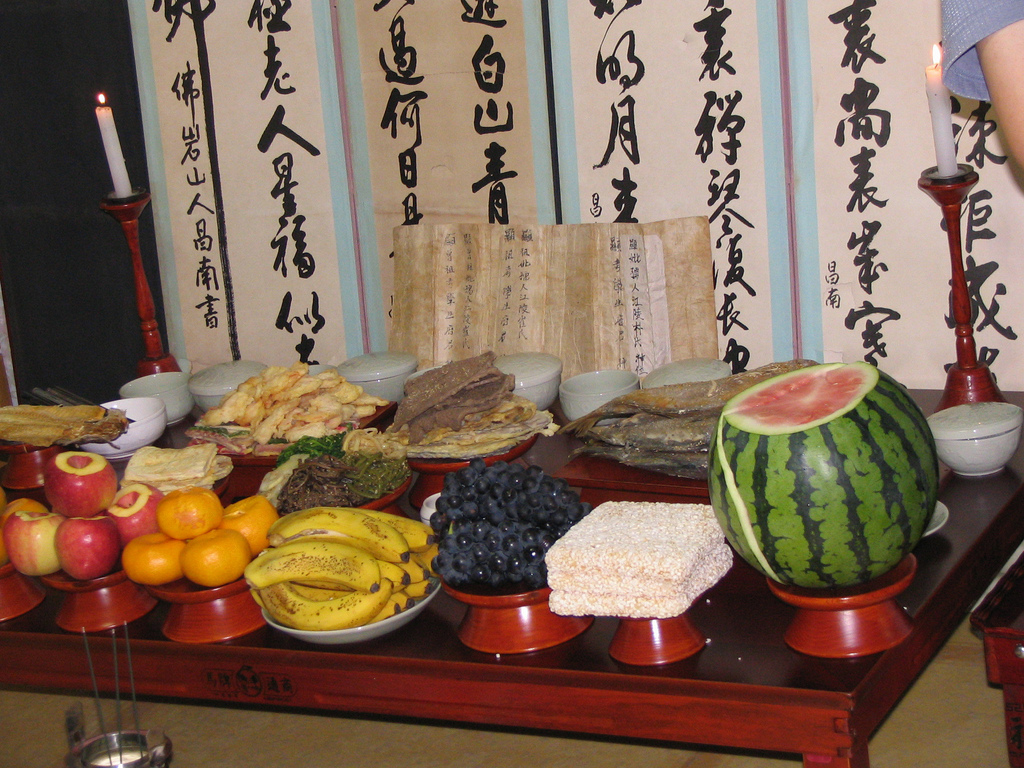
Charye is a table of rice, soup, fruit and rice cakes laid for the ancestors at Chuseok and Seollal, and jesa is held on the anniversary of a death. Families also visit and tidy the graves in a custom called seongmyo.

Read: Jesa

🇻🇳 Vietnam

Every household keeps an ancestor altar, and the death anniversary, or gio, is marked with a family meal and offerings. Tet begins with a visit to graves and an invitation to the ancestors to join the celebration.

Vietnamese folk religion, being written

🇰🇭 Cambodia

Pchum Ben lasts fifteen days in autumn, when families take rice and offerings to the pagoda for monks to pass on to the spirits of seven generations. The days are serious and communal.

Read: Pchum Ben

Compare all 19 places

Traditions to start with

Questions people ask

Is ancestor remembering a religious practice?

Often, but not always. It is part of many faiths and traditional belief systems, and in some places it is simply a family custom with no creed attached. People take part for love, duty, habit or all three.

Why are offerings of food common?

Food is how families show care, so it is how they show it to the dead. The living usually share the meal afterwards, which turns the offering into a reunion.

Do all cultures remember the dead on one fixed day?

Many do, in autumn or early spring, but others use the death anniversary of each person, or a rite at any time of year. Some use all three.

What is the difference between mourning and ancestor remembrance?

Mourning is the period just after a death. Ancestor remembrance carries on for years or generations, often with a lighter and more affectionate tone.

How can someone start a family custom of remembrance?

Many families begin small: a photograph and a candle, a favourite dish cooked once a year, or a story told on a chosen day. A simple, regular habit usually lasts better than a grand one.

About this page

Written by the EveryParampara desk with AI assistance. Customs differ from place to place and family to family. If this is your tradition and we have it wrong, tell us.

Remembering the ancestors on EveryParampara

The traditions written up so far, best known first.

🇮🇳 Imphal, India and 2 moreLai Haraobaꯂꯥꯏ ꯍꯔꯥꯎꯕ A ritual dance and music festival kept by the Meitei people to please their deities.Festival 🇵🇱 Poland and 6 morePolaznik The first visitor to cross the threshold at Christmas, read as a sign of the year to comeFolklore 🇷🇴 RomaniaCapra A New Year's ritual in Romania where a masked dancer visits homes to bring luck and predict the weather.Festival 🇦🇹 Austria and 2 morePerchten Masked midwinter walks in the Alps, with carved wooden masks and sheepskinFolklore 🇮🇳 India and 5 moreFirst haircut A rite of passage marking a child's first shave or trim across many cultures and faiths.Rite of passage 🇰🇿 Kazakhstan and 1 moreJeti ataЖеті ата A Kazakh custom requiring knowledge of seven direct ancestors to ensure healthy marriages and tribal identity.Folklore 🇷🇴 Bucharest, Romania and 2 moreCaloian A Romanian rainmaking and fertility ritual centered on the creation, funeral, and rebirth of a clay effigy.Festival 🇬🇧 United Kingdom and 4 moreTelling the bees A Western European custom of informing honeybees about major household events like deaths and weddings.Folklore 🇮🇳 Haridwar, IndiaAntam Sanskarਅੰਤਮ ਸੰਸਕਾਰ (Antam Sanskar) The final rites of passage in Sikhism, involving prayer, cremation, and the dispersal of ashes.Rite of passage 🇮🇷 Iran and 2 moreRowzeh-khani A Shia Muslim ritual of reciting mourning narratives about the Battle of Karbala.Spiritual 🇲🇽 MexicoMesoamerican bloodletting A ritual practice of self-cutting used by ancient Maya and other Mesoamerican elites to communicate with the divine.Spiritual 🇬🇪 GeorgiaTheodore's Saturday The first Saturday of Lent, kept with boiled wheat and visits to the gravesSpiritual · Sweets given and shared 🇮🇷 Kashan, IranOmar Koshanعمرکشان A yearly carnival in Iran where social roles reverse to honor Fatima al-Zahra and remember historical figures.Festival 🇮🇳 India and 5 moreUrs-e-Razaviعرس اعلی حضرت A three-day annual Sufi gathering honouring the legacy of Imam Ahmad Raza KhanSpiritual 🇩🇿 Djanet, Algeria and 1 moreSebibaسبيبة (Arabic), ⵙⴱⵉⴱⴰ (Tifinagh) A Tuareg festival and dance in the Algerian Sahara marking the Islamic New Year and Ashura.Festival 🇰🇬 Bishkek, Kyrgyzstan and 1 moreAk-kalpakАк калпак A traditional Kyrgyz four-sided white wool felt hat worn by men across generationsDress 🇮🇳 Goa, IndiaVeerabhadra A ritual dance of a fierce figure performed in Goa during the Shigmo festival and on Chaitra Poornima.Performance 🇸🇦 Saudi Arabia and 3 moreGhadir Khummغَدِير خُمّ A historic sermon and annual festival marking Ali's role in early Islam.Festival 🇲🇬 Antananarivo, MadagascarSavika Traditional Betsileo zebu wrestling and courtship rite in MadagascarGame 🇬🇧 United Kingdom and 1 moreCorpse road Historical paths used to carry the dead to parish burial grounds across Britain and Ireland.Rite of passage 🇳🇬 NigeriaKwagh-Hir A Tiv puppet theatre and masquerade performance from central Nigeria that uses masks and marionettes to tell moral storiPerformance 🇭🇷 CroatiaBadnjakBadnji dan A Christmas Eve oak log burned in the hearth across Croatia to welcome the holiday.Festival · Fasting and breaking the fast 🇸🇾 Syria and 1 moreThree Sundays of Commemoration A Maronite Christian observance held on the three Sundays before Lent to remember the departed.Spiritual · Dinner 🇨🇳 China and 1 moreTaiyin Xingjun太陰星君 The Chinese moon goddess, honoured at Mid-Autumn with incense, mooncakes and prayersSpiritual · Sweets given and shared 🇳🇬 Nigeria and 1 moreOkpu Aguokpu agụ A knitted wool cap from southeastern Nigeria, historically worn by warriors to display status and now used in ceremoniesDress 🇿🇦 South AfricaIsidwaba A knee-length leather skirt of cowhide or goatskin, worn by married Zulu womenDress 🇱🇹 LithuaniaLithuanian cross craftingLietuvos kryždirbystė A Lithuanian folk art of carving wooden crosses that blend Christian faith with ancient Baltic symbols.Craft 🇨🇳 Taiyuan, ChinaGuan Li冠禮 The traditional Chinese coming-of-age capping ceremony for young menRite of passage 🇵🇭 PhilippinesBuklog A thanksgiving ritual of the Subanen people in the Philippines, honoring spirits through offerings and dance.Spiritual 🇽🇰 Gjilan, KosovoFlaka e Janarit A winter arts festival in Kosovo honoring national martyrs through music, drama and verseFestival 🇲🇼 Bolero, MalawiGonapamhanya festival An annual gathering of the Tumbuka people honouring their first paramount chiefFestival · Feasts and festival meals 🇧🇼 D'Kar, BotswanaKuru Dance and Music Festival A gathering of San communities in Botswana to share songs, stories and sacred dancesPerformance 🇨🇲 Bafoussam, CameroonNyang Nyang FestivalNyan-Nyang A four-month Bamileke harvest festival and initiation rite in western CameroonFestival 🇵🇭 PhilippinesBinirayan Festival An annual December cultural festival in Antique celebrating Panay's Malay settlementFestival 🇲🇼 Chonde, MalawiMulhako wa Alhomwe An annual gathering in Malawi where the Lhomwe people celebrate their language, dance and heritage.Festival 🇲🇲 Bagan, MyanmarAtar-ohအတာအိုး A terracotta vessel prepared for the Myanmar New Year to welcome celestial blessings and purify the home.Festival 🇧🇹 Punakha, BhutanTraditional Day of OfferingBuelwa Phuewi Nyim A Bhutanese New Year marked by offerings to Zhabdrung Ngawang Namgyal and family feasts.Festival · Breakfast 🇮🇳 IndiaOran lands Sacred groves and community-conserved pastures in Rajasthan dedicated to local deities.Spiritual 🇨🇾 CyprusLimassol CarnivalΚαρναβάλι Λεμεσού A ten-day spring festival in Limassol featuring parades, costumes, satire and foam fights before Lent.Festival 🇪🇸 SpainGragerגראַגער (grager) A noisemaker used by Jewish communities to drown out the name of Haman during Purim readings.Festival 🇲🇼 Rumphi, Malawi and 2 moreTumbuka dances and festivals Dances for healing and celebration, and the yearly festivals that keep themPerformance 🇮🇳 IndiaSahasra Purna Chandrodayamसहस्र-(पूर्ण)चन्द्र-दर्शन A Hindu rite marking a person's thousandth full moon, celebrated around age eighty-one.Rite of passage 🇿🇲 Maala, ZambiaShimunenga An annual Zambian celebration of cattle displays, dances, and ancestral memoryFestival · Tea, coffee and drinking ceremonies 🇨🇳 Huizhou, ChinaHui-style architecture A traditional Chinese building style of white walls, dark tiles and horse-head gablesCraft 🇮🇳 Delhi, IndiaSacred groves of India Communal forest sanctuaries across India where religious belief protects biodiversity and local resources.Spiritual 🇪🇸 Córdoba, Spain and 5 moreFiesta de las Cruces A May festival where communities decorate crosses with flowers and crafts to celebrate faith and local heritage.Festival 🇵🇸 Jerusalem, Palestine and 1 moreThursday of the Deadخميس الأموات A spring day of cemetery visits, prayer, and shared yellow breads across the LevantSpiritual · Sweets given and shared 🇮🇷 IranKhāne-takānīخانه‌تکانی A spring cleaning ritual in Iran that prepares homes for the Norouz new year.Festival

Photo credits on this page

The small pictures above come from Wikimedia Commons under free licences. Some are cropped to fit.
The weekly EveryParampara

Every week: one tradition from somewhere new, what is being celebrated around the world this week, and one idea explained.