🇭🇰 Traditions of Hong Kong
9 traditions from Hong Kong, best known first, across 3 cities and towns.
Hong Kong traditions rest on a foundation of Lingnan Cantonese culture combined with over a century of British colonial history. The territory celebrates both Chinese festivals and Western holidays, while its people express a unique identity through traditional characters, local dialects, and the playful mixing of English into Cantonese.
Hong Kong blends Lingnan Cantonese customs with habits developed over more than a century of British administration. Daily life brings together traditional Chinese customs, Western calendar dates, and an inventive local vernacular. While Cantonese remains the primary speech across the city, community heritage is also carried by indigenous groups such as the Hakka and Tanka. This layered history gives the territory its distinctive personality, shaped by global ties and enduring local connections.
The festival calendar
The official calendar mirrors the dual roots of the territory. Families observe major Chinese dates throughout the year, including Lunar New Year, the Dragon Boat Festival, the Mid-Autumn Festival, and Buddha's Birthday. Alongside these ancestral celebrations, the city marks Western occasions such as Easter and Christmas. Public holidays also include civic dates, such as Hong Kong Special Administrative Region Establishment Day in July and National Day in October. Together, these statutory and public breaks give workers time to rest, gather with relatives, and maintain community observances across the changing seasons.
Cantonese and hybrid speech
Cantonese is the primary tongue used in everyday conversation, popular entertainment, and local cinema. Over decades of contact with the wider world, Hong Kong Cantonese has absorbed terms from English as well as Japanese. Many residents regularly insert English vocabulary into their everyday speech, creating a distinct conversational style known as Kongish. The government officially maintains a policy recognizing Cantonese, English, and Mandarin. In writing, residents use Traditional Chinese characters, supplemented by locally created characters that allow conversational Cantonese expressions to appear directly in casual messages, internet forums, and public notices.
Indigenous communities and speech
Long before urban expansion, indigenous groups established their own distinct lifeways across the territory. In the New Territories, Hakka communities settled in fortified walled villages, maintaining their own language, building styles, and customs, which differ significantly from standard Cantonese ways. Older residents in these settlements also preserve Waitau, another ancestral tongue. Along the coast and harbors, Tanka fishing communities cultivated maritime traditions and their own distinctive variety of Cantonese. Although modern city life has transformed the region, these indigenous lineages continue to represent the foundational rural and coastal history of Hong Kong.
A distinct local identity
More than a century and a half of British governance helped shape a distinct outlook among local residents. Living between European administrative structures and Lingnan customs, people developed an identity that bridges Chinese roots and Western civic forms. Many residents identify specifically as Hongkongers to describe this particular cultural mixture. While recent demographic shifts and legal developments have influenced how people define themselves, the everyday culture remains defined by this balance. Legal traditions, education, and local perspectives continue to reflect a long history of mediating between Eastern and Western worlds.
The facts in this overview come from the Wikipedia article "Culture of Hong Kong", written by its contributors and used under the CC BY-SA 4.0 licence. EveryParampara rewrote the text in its own words, with AI assistance, and compares every page with the article to make sure no passage is copied. It may be reused under the same CC BY-SA 4.0 licence with a link back.
Cities, towns and villages of Hong Kong
 🇨🇳 Guangzhou, China and 1 moreDim sum點心 (traditional Chinese), 点心 (simplified Chinese)
Small dishes shared with tea, eaten as brunch in Cantonese teahouses and restaurantsTable custom · Breakfast
🇨🇳 Guangzhou, China and 1 moreDim sum點心 (traditional Chinese), 点心 (simplified Chinese)
Small dishes shared with tea, eaten as brunch in Cantonese teahouses and restaurantsTable custom · Breakfast
 🇨🇳 China and 5 moreYum cha飲茶
A Cantonese breakfast of dim sum and tea, eaten slowly in large groupsTable custom · Breakfast
🇨🇳 China and 5 moreYum cha飲茶
A Cantonese breakfast of dim sum and tea, eaten slowly in large groupsTable custom · Breakfast
 🇨🇳 Shanghai, China and 1 moreCheongsam旗袍 (qípáo), 長衫 (chángshān)
A fitted one-piece Chinese dress with a high collar and side slits, worn since the 1920sDress
🇨🇳 Shanghai, China and 1 moreCheongsam旗袍 (qípáo), 長衫 (chángshān)
A fitted one-piece Chinese dress with a high collar and side slits, worn since the 1920sDress
 🇭🇰 Cheung Chau, Hong KongCheung Chau Bun Festival包山節
A week of vegetarian days, bun towers and a midnight scramble on a Hong Kong islandFestival
🇭🇰 Cheung Chau, Hong KongCheung Chau Bun Festival包山節
A week of vegetarian days, bun towers and a midnight scramble on a Hong Kong islandFestival
 🇻🇳 Saigon, Vietnam and 5 moreBánh mì
A Vietnamese baguette sandwich filled with meats, pickles, herbs, and condiments.Table custom · Breakfast
🇻🇳 Saigon, Vietnam and 5 moreBánh mì
A Vietnamese baguette sandwich filled with meats, pickles, herbs, and condiments.Table custom · Breakfast
 🇨🇳 China and 5 moreJoss paper金紙 (jīnzhǐ)
Paper money burned for ancestors and gods, folded and offered in Chinese worshipSpiritual
🇨🇳 China and 5 moreJoss paper金紙 (jīnzhǐ)
Paper money burned for ancestors and gods, folded and offered in Chinese worshipSpiritual
 🇨🇳 China and 2 moreCantonese opera粵劇
One of the major forms of Chinese opera, sung in Cantonese in southern ChinaPerformance
🇨🇳 China and 2 moreCantonese opera粵劇
One of the major forms of Chinese opera, sung in Cantonese in southern ChinaPerformance
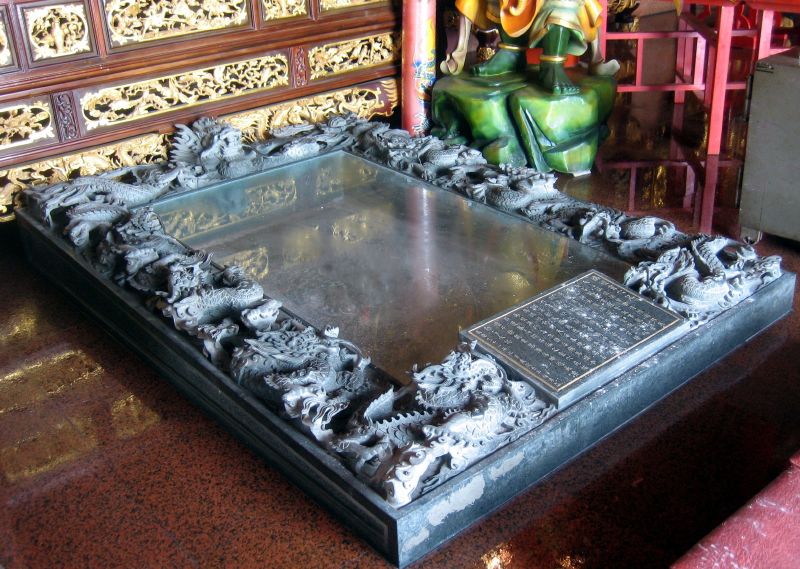 🇨🇳 Meizhou Island, China and 5 moreMazu媽祖
A sea goddess of the Chinese coast, asked for calm water and a safe returnSpiritual
🇺🇸 United States and 1 moreMarco Polo
A swimming pool tag game where one blindfolded player uses sound to find othersGame
🇨🇳 Meizhou Island, China and 5 moreMazu媽祖
A sea goddess of the Chinese coast, asked for calm water and a safe returnSpiritual
🇺🇸 United States and 1 moreMarco Polo
A swimming pool tag game where one blindfolded player uses sound to find othersGame
Photo credits on this page
The small pictures above come from Wikimedia Commons under free licences. Some are cropped to fit.
- Cheongsam: Jacklee ., CC BY-SA 4.0, source
- Bánh mì: Andrea Nguyen, CC BY 2.0, source
- Cheung Chau Bun Festival: .怪貓., CC BY 2.0, source
- Dim sum: Kolumbusjogger, CC BY-SA 3.0, source
- Yum cha: Infomofo, CC BY-SA 2.0, source
- Joss paper: Vmenkov, CC BY-SA 3.0, source
- Cantonese opera: Roland Tanglao, CC BY 2.0, source
- Mazu: Prince Roy, CC BY-SA 3.0, source