🇦🇹 Traditions of Austria
48 traditions from Austria, best known first, across 12 cities and towns.
Austrian cultural life combines Alpine customs with centuries of imperial music and shared Central European cooking. Classical concert halls, lively social ballroom dances, and mountain singing exist alongside a daily rhythm anchored by afternoon snacks and slow-simmered regional dishes.
Shaped by Germanic, Slavic, Celtic, and Roman roots, Austrian life is closely tied to its Alpine landscape and Catholic history. Long years under the Habsburg monarchy left a deep imprint on both city halls and country tables. Today, traditions span grand winter balls and world-renowned classical orchestras to communal mountain yodeling, accordion-led folk tunes, and hearty home-style meals shared at the end of the working day.
Classical and choral arts
Vienna grew into an international music capital under Habsburg patronage, nurturing the symphonies and quartets of composers such as Haydn, Mozart, and Beethoven. Today, the Vienna Philharmonic maintains a democratic tradition begun in 1842, where orchestra members vote on all major decisions. Every year, their New Year concert reaches listeners around the globe from the Golden Hall of the Musikverein. Choral singing remains equally grounded in history. Founded in 1498 by Emperor Maximilian I, the Vienna Boys' Choir trains young singers at the Palais Augarten, continuing centuries of vocal performance across classical sacred and secular repertoires.
Folk dances and songs
Outside the formal concert halls, rural communities developed distinct musical customs. In the Alps, callers practiced juchazn, a form of throat singing and yodeling used to communicate over open mountain ranges. Traditional instrumental music includes Viennese Schrammelmusik, performed with an accordion and a two-necked guitar, alongside modern Alpine punk fusions. Social dancing carries similar communal roots. Couples dance the Schuhplattler, the polka, and the ländler. Originating around 1720, the ländler required partners to dance in close contact, drawing early disapproval from church authorities before gradually evolving into the modern waltz.
The winter ball season
Ballroom traditions reach their peak during the winter season. The most famous gathering is the Vienna Opera Ball, held at the State Opera on the Thursday before Ash Wednesday. Dating back to 1936, the celebration brings together thousands of guests. The evening opens formally when one hundred and eighty paired dancers enter the floor in synchronized fashion. Following the traditional call of 'Alles Walzer', based on the legacy of Johann Strauss the Younger, the floor opens to all attendees, blending theatrical grandeur with an evening of social waltzing.
Daily table and snacks
Daily eating patterns in Austria balance simple morning routines with relaxed mid-day breaks. Breakfast is typically continental, consisting of rolls served with butter, jam, cheeses, or cold meats. While a heavy midday meal was once the standard, modern working schedules mean families now eat their main warm dinner in the evening. Between meals, people pause for a Jause, an informal snack of bread with cold cuts and cheese. In a more rustic setting, this becomes a Brettljause, where cold meats, cheeses, and spreads like spicy Liptauer are served together on a wooden board.
Imperial cooking and pastries
Austrian cuisine reflects culinary exchanges with Bohemia, Hungary, Bavaria, and Northern Italy. Beef is central to classic cooking, featured in clear golden Rindsuppe, tender boiled Tafelspitz, and slow-simmered Saftgulasch prepared with rich mounds of braised onions. Pork dishes make full use of offal, blood sausages, and specific cuts such as Fledermaus. Sweets remain a defining part of the meal. Bakers prepare filled yeast Germknödel topped with poppy seeds and melted butter, fruit-filled Marillenknödel, layered strudels, and Kaiserschmarrn, a fluffy shredded pancake served warm with stewed fruit or compote.
The facts in this overview come from the Wikipedia article "Culture of Austria", written by its contributors and used under the CC BY-SA 4.0 licence. EveryParampara rewrote the text in its own words, with AI assistance, and compares every page with the article to make sure no passage is copied. It may be reused under the same CC BY-SA 4.0 licence with a link back.
The table in Austria
Foods and drinks by the moment they belong to.
Cities, towns and villages of Austria
 🇭🇺 Budapest, Hungary and 2 moreHungarian folk dance
A collection of traditional dances kept by Hungarians in Hungary and across the diaspora.Performance
🇭🇺 Budapest, Hungary and 2 moreHungarian folk dance
A collection of traditional dances kept by Hungarians in Hungary and across the diaspora.Performance
 🇬🇧 United Kingdom and 3 moreMumming
A medieval European custom of masked house-to-house visits, performances and seasonal revelry.Festival
🇬🇧 United Kingdom and 3 moreMumming
A medieval European custom of masked house-to-house visits, performances and seasonal revelry.Festival
 🇭🇺 Hungary and 5 moreCsárdás
A Hungarian folk dance that moves from a slow start to a fast finish, kept in Hungary and neighboring regions.Performance
🇭🇺 Hungary and 5 moreCsárdás
A Hungarian folk dance that moves from a slow start to a fast finish, kept in Hungary and neighboring regions.Performance
 🇦🇹 Vienna, Austria and 3 moreLändler
A three-quarter time partner dance from the Alpine region, known for hopping steps and yodeling.Performance
🇦🇹 Vienna, Austria and 3 moreLändler
A three-quarter time partner dance from the Alpine region, known for hopping steps and yodeling.Performance
 🇬🇧 United Kingdom and 5 moreChristmas carol
Festive songs and hymns sung during the Christmas season and door to doorPerformance
🇬🇧 United Kingdom and 5 moreChristmas carol
Festive songs and hymns sung during the Christmas season and door to doorPerformance
 🇦🇹 Vienna, Austria and 2 moreViennese waltzWiener Walzer
A fast rotary partner dance kept across Austria and Europe, celebrated in ballrooms and social halls.Performance
🇦🇹 Vienna, Austria and 2 moreViennese waltzWiener Walzer
A fast rotary partner dance kept across Austria and Europe, celebrated in ballrooms and social halls.Performance
 🇦🇹 Vienna, Austria and 4 moreLipizzanerLipicanec
A gray riding horse breed and centuries-old tradition of classical dressage kept by the Spanish Riding School.Performance
🇦🇹 Vienna, Austria and 4 moreLipizzanerLipicanec
A gray riding horse breed and centuries-old tradition of classical dressage kept by the Spanish Riding School.Performance
 🇨🇭 Appenzell, Switzerland and 5 moreYodeling
A singing style switching between chest voice and falsetto, kept as a folk tradition across the Alps and globally.Performance
🇨🇭 Appenzell, Switzerland and 5 moreYodeling
A singing style switching between chest voice and falsetto, kept as a folk tradition across the Alps and globally.Performance
 🇩🇪 Germany and 5 moreMaypole
A tall wooden pole, garlanded and danced around, raised at May Day, Whitsun or MidsummerFestival
🇩🇪 Germany and 5 moreMaypole
A tall wooden pole, garlanded and danced around, raised at May Day, Whitsun or MidsummerFestival
 🇦🇹 Vienna, AustriaVienna New Year's ConcertNeujahrskonzert der Wiener Philharmoniker
A morning of waltzes and polkas on 1 January, played by the Vienna PhilharmonicPerformance
🇦🇹 Vienna, AustriaVienna New Year's ConcertNeujahrskonzert der Wiener Philharmoniker
A morning of waltzes and polkas on 1 January, played by the Vienna PhilharmonicPerformance
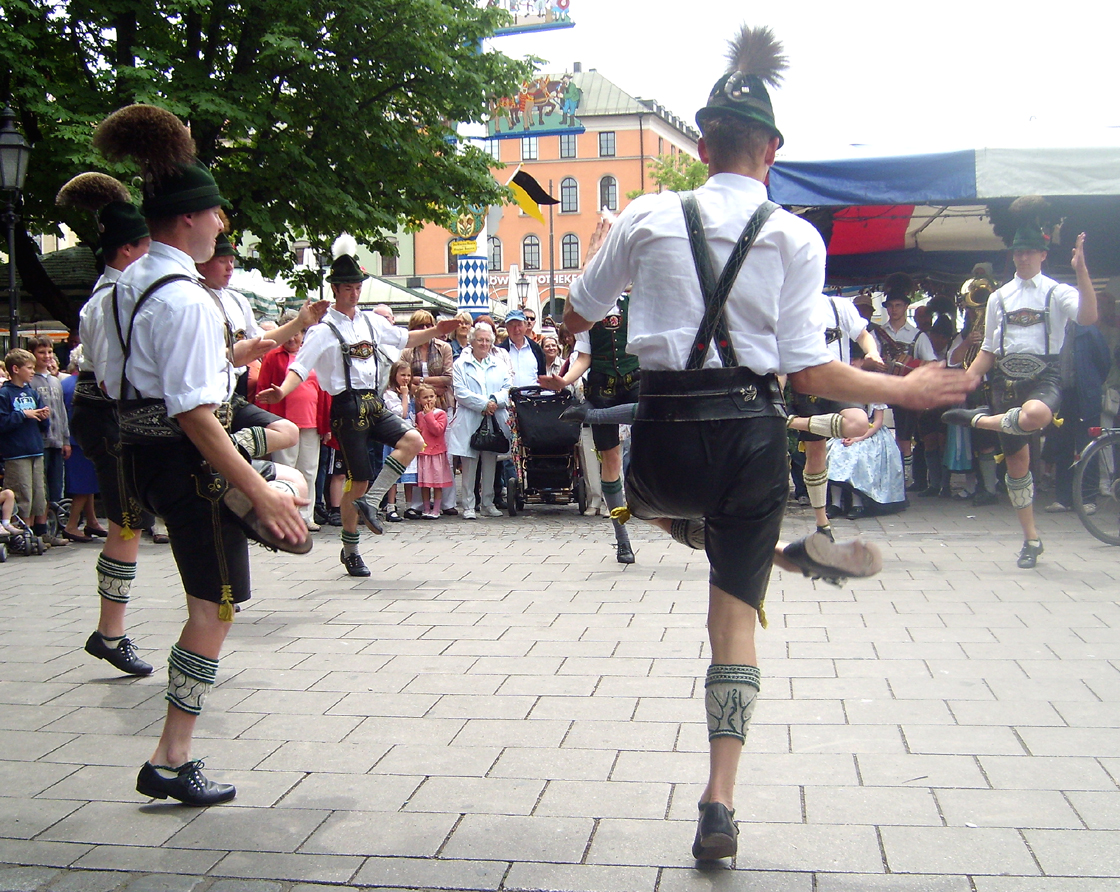 🇩🇪 Munich, Germany and 3 moreSchuhplattler
An Alpine folk dance of stomps, claps and flat-hand slaps on shoes, knees and thighsPerformance
🇩🇪 Munich, Germany and 3 moreSchuhplattler
An Alpine folk dance of stomps, claps and flat-hand slaps on shoes, knees and thighsPerformance
 🇦🇹 Vienna, AustriaViennese coffee house cultureWiener Kaffeehauskultur
A Viennese social ritual where patrons linger for hours with a single coffee and newspapers.Etiquette · Tea-time and snacking customs
🇦🇹 Vienna, AustriaViennese coffee house cultureWiener Kaffeehauskultur
A Viennese social ritual where patrons linger for hours with a single coffee and newspapers.Etiquette · Tea-time and snacking customs
 🇦🇹 Oberndorf bei Salzburg, Austria and 2 moreSilent NightStille Nacht, heilige Nacht
A Christmas carol composed in Austria in 1818, now sung worldwide as a symbol of peace.Performance
🇦🇹 Bludenz, AustriaBludenzer Tage zeitgemäßer Musik
An international festival of contemporary classical music held annually in BludenzPerformance
🇦🇹 Oberndorf bei Salzburg, Austria and 2 moreSilent NightStille Nacht, heilige Nacht
A Christmas carol composed in Austria in 1818, now sung worldwide as a symbol of peace.Performance
🇦🇹 Bludenz, AustriaBludenzer Tage zeitgemäßer Musik
An international festival of contemporary classical music held annually in BludenzPerformance
Photo credits on this page
The small pictures above come from Wikimedia Commons under free licences. Some are cropped to fit.
- Christmas carol: Prathyush Thomas, GFDL 1.2, source
- Maypole: Uploaded by Mikael Häggström, CC0, source
- Viennese waltz: Sigismund von Dobschütz, CC BY-SA 3.0, source
- Hungarian folk dance: Koós Ildikó, CC BY-SA 4.0, source
- Ländler: Emil Rau, Public domain, source
- Mumming: Flemish illuminator Jehan de Grise and his workshop, 1338-1344, Public domain, source
- Vienna New Year's Concert: Michal Osmenda, CC BY 2.0, source
- Csárdás: Unknown author, Public domain, source
- Schuhplattler: Harald Bischoff, CC BY-SA 3.0, source
- Yodeling: Paebi, CC BY-SA 4.0, source
- Viennese coffee house culture: Photo: Andreas Praefcke, CC BY 3.0, source
- Silent Night: Franz Xaver Gruber (1787–1863), Public domain, source
- Lipizzaner: Srdjan Živulovič, Attribution, source